
Educational article

Signs of breast implant rupture

A ruptured implant behaves very differently depending on whether it's saline or silicone. Knowing the signs — and the fact that silicone rupture often has none — helps you respond at the right time.

Saline vs silicone: rupture looks completely different

The single most important thing to understand is that the two implant types fail in opposite ways. A saline rupture is obvious within days; a silicone rupture often produces no signs at all. Knowing which type you have shapes what to watch for.

Saline rupture — the obvious deflation

When a saline implant ruptures, the salt-water filler leaks out through the tear and is harmlessly absorbed by your body. The visible effect is rapid: the breast deflates and loses size and shape over hours to days, ending up noticeably smaller and different from the other side. It's not dangerous — the saline is harmless — but it's cosmetically unmistakable, so saline rupture essentially announces itself.

Silicone rupture — the "silent" rupture

Modern silicone implants contain a cohesive gel that tends to stay within the implant shell or the surrounding capsule even after the shell tears. As a result, a silicone rupture frequently causes no change in size, shape or symptoms at all — which is why it's called a "silent rupture." Many are discovered only on imaging done for another reason. This is precisely why imaging surveillance matters for silicone implants (see how long implants last).

Symptoms that can occur

While silicone rupture is often silent, sometimes — with either type — there are signs as the tissue around the implant reacts:

  • A change in breast shape or size, or new asymmetry
  • New firmness or hardening (which can also signal capsular contracture)
  • Lumps, swelling or a change in contour
  • Tenderness, discomfort or an aching sensation
  • Tingling, burning or other altered sensation

None of these is exclusive to rupture, so they warrant assessment rather than alarm. But for a saline implant, sudden deflation is the clear giveaway, and for silicone, any of these changes is worth imaging.

How rupture is detected

Because silicone rupture is often invisible, imaging is the only reliable way to confirm it. An MRI is the most sensitive test for detecting a silicone shell tear and gel outside the shell; ultrasound is a widely used and more accessible alternative. A clinical examination alone cannot rule out a silent silicone rupture, which is why the FDA recommends periodic imaging — starting around 5–6 years after surgery and then every 2–3 years.

What to do if you suspect a rupture

A ruptured implant is not a medical emergency — you don't need to rush to A&E. But it should be assessed and, once confirmed, addressed. The standard treatment is removal of the ruptured implant and the surrounding capsule, with the option to replace it, change size, or remove implants altogether at the same time — see implant replacement and implant size change. Many patients use the opportunity to reassess what they want, rather than simply swapping like-for-like.

The bottom line: trust deflation as the sign of saline rupture, don't trust the absence of symptoms with silicone, and keep up with imaging — it's the only way to catch a silent rupture before it's been there for years.
What are the signs of a ruptured breast implant?

It depends on the type. A saline implant deflates obviously over hours to days, leaving the breast smaller and asymmetric. A silicone implant often ruptures 'silently' with no signs at all. Possible symptoms with either include shape or size change, new firmness, lumps, swelling, tenderness or altered sensation.

How do I know if my silicone implant has ruptured?

Often you can't tell from symptoms — silicone rupture is frequently 'silent', with the cohesive gel staying within the shell or capsule. Imaging is the only reliable way to confirm it: an MRI is most sensitive, and ultrasound is a widely used alternative. This is why periodic imaging is recommended for silicone implants.

What does a saline implant rupture look like?

Obvious deflation — the salt-water filler leaks out and is harmlessly absorbed, so the breast loses size and shape over hours to days and ends up noticeably smaller than the other side. It isn't dangerous, but it's cosmetically unmistakable, so a saline rupture essentially announces itself.

Is a ruptured breast implant dangerous?

It's not a medical emergency. A saline leak is harmless, and a silicone leak tends to stay trapped in the surrounding tissue. It should be assessed and, once confirmed, addressed — but you don't need to rush to emergency care. The standard treatment is removal of the implant and capsule, with replacement optional.

How is a ruptured implant treated?

By removing the ruptured implant together with the surrounding capsule. At the same operation you can choose to replace the implant, change to a different size or type, or remove implants altogether. Many patients use the opportunity to reassess what they want rather than simply swapping like-for-like.

Can an MRI or ultrasound detect a ruptured implant?

Yes — imaging is the reliable way to detect rupture, especially the silent silicone kind. MRI is the most sensitive test for a shell tear and gel outside the shell; ultrasound is a more accessible alternative. A physical examination alone cannot rule out a silent silicone rupture.

Related guides

Related guides

Ready to talk about your breast revision?

Free WhatsApp consultation in English with Dr. Erdal's clinic. Send your photos for an initial assessment.

Open WhatsApp instead

Or email info@ayhanisikerdal.com

Quick enquiry

Send a quick message

Government Authorisation

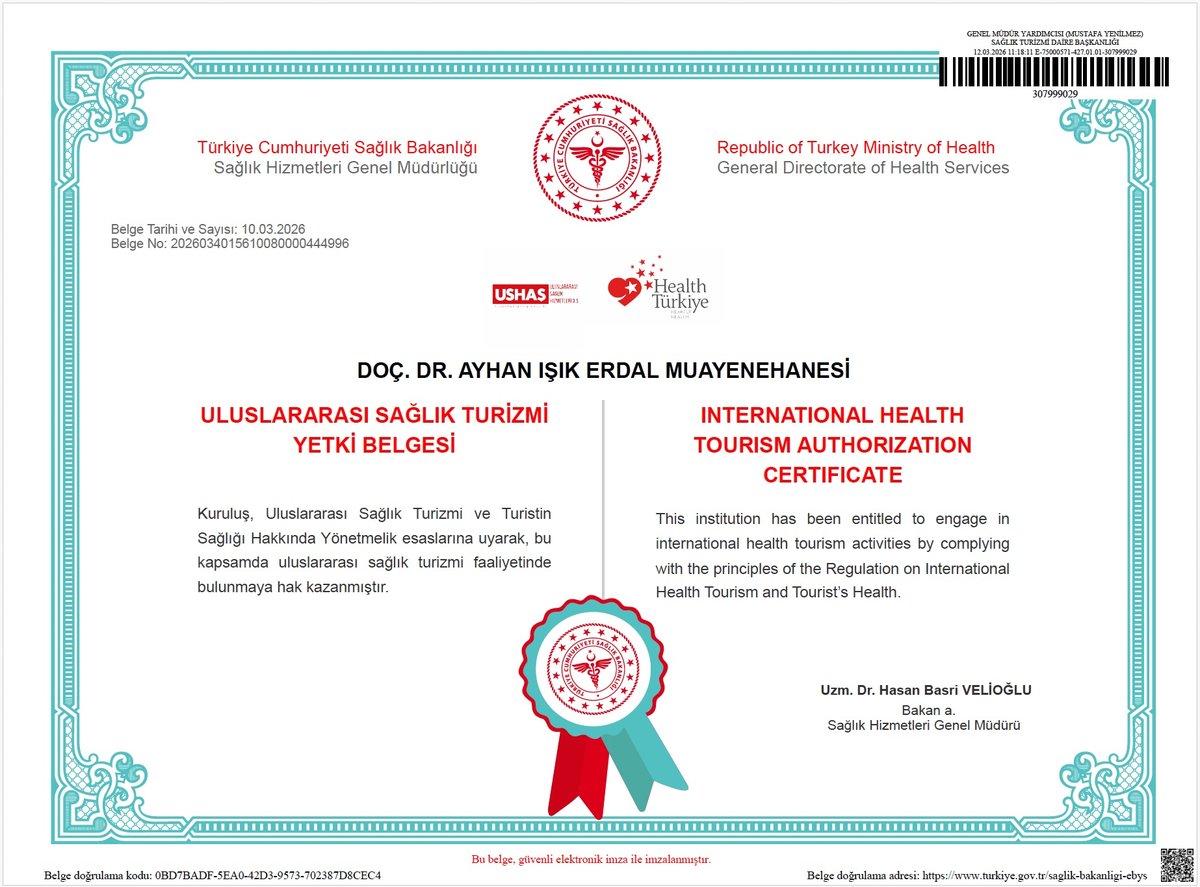
International Health Tourism Authorization Certificate

This clinic is officially authorised by the Republic of Türkiye Ministry of Health (Sağlık Bakanlığı, General Directorate of Health Services) to provide international health tourism services. The Ministry audits the clinic's surgeon credentials, facility standards, infection-control protocols, and complication-tracking systems before issuing this certification.

Authorization No.
2026034015610080000444996
Issued to
Doç. Dr. Ayhan Işık Erdal Muayenehanesi
Issue date
10 March 2026
Verifiable at
turkiye.gov.tr/saglik-bakanligi-ebys

Click certificate to view at full resolution. Document carries digital signature and QR-code verification on the original.