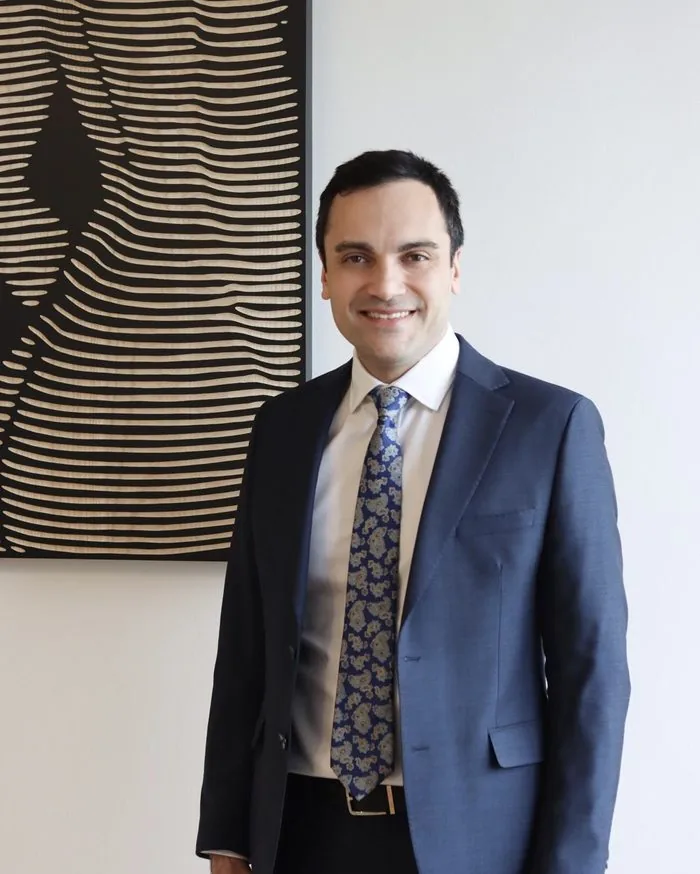
Medically reviewed by
Assoc. Prof. Dr. Ayhan Işık Erdal, MD, FACS, FEBOPRAS
Plastic, Reconstructive & Aesthetic Surgeon
· Last reviewed
The most common revision indication. Either the original implant size was wrong from the start, or your priorities have changed. Either way, the operation is straightforward technically — but the choice of new size determines whether you'll be happy this time.
Of all revision indications, size change requests fall into three categories that don't always overlap with regret:
None of these are signs of a poor original surgery. They are normal evolutions in what someone wants from their body — and revision is the appropriate response.
The more common direction. Two technical considerations dominate:
The decision about whether to combine downsizing with a breast lift is the most important one. If the skin won't retract sufficiently, a lift addresses the looseness. Without a lift, you may have a smaller implant in a larger envelope — which looks empty.
Less common as a pure revision; more often requested as part of a complete satisfaction increase. Technical considerations:
When breasts are uneven — either from pre-existing asymmetry or asymmetric primary surgery — different volume implants can be selected. Volume differences of up to 50 cc between sides are common and well-tolerated. Larger differences (>75 cc) are achievable but may require additional asymmetric pocket work.
Operative time: typically 90 minutes to 2.5 hours.
Generally easier than primary augmentation:
There's no fixed limit, but practical considerations apply. Soft-tissue cover thickness, skin envelope elasticity, and pocket dimensions all constrain how much volume can be added safely. Increases of 50-200 cc are common; larger increases may require staged procedures or pocket modifications.
Possibly. The skin envelope was stretched by the larger implants. After down-sizing, the envelope may not retract sufficiently, leaving some looseness. A concurrent breast lift is often discussed and may be necessary depending on degree of skin redundancy.
In most cases, yes. The original inframammary or peri-areolar incision is reopened, the existing implant removed, and the new implant placed. No new scars are created.
Through measurement of your chest dimensions, soft-tissue cover thickness, the original implant data (if available), and your specific volume goals. Sizing is done with implant sizers in office; final implant choice is confirmed before surgery.
Free WhatsApp consultation in English with Dr. Erdal's clinic. Send your photos for an initial assessment.
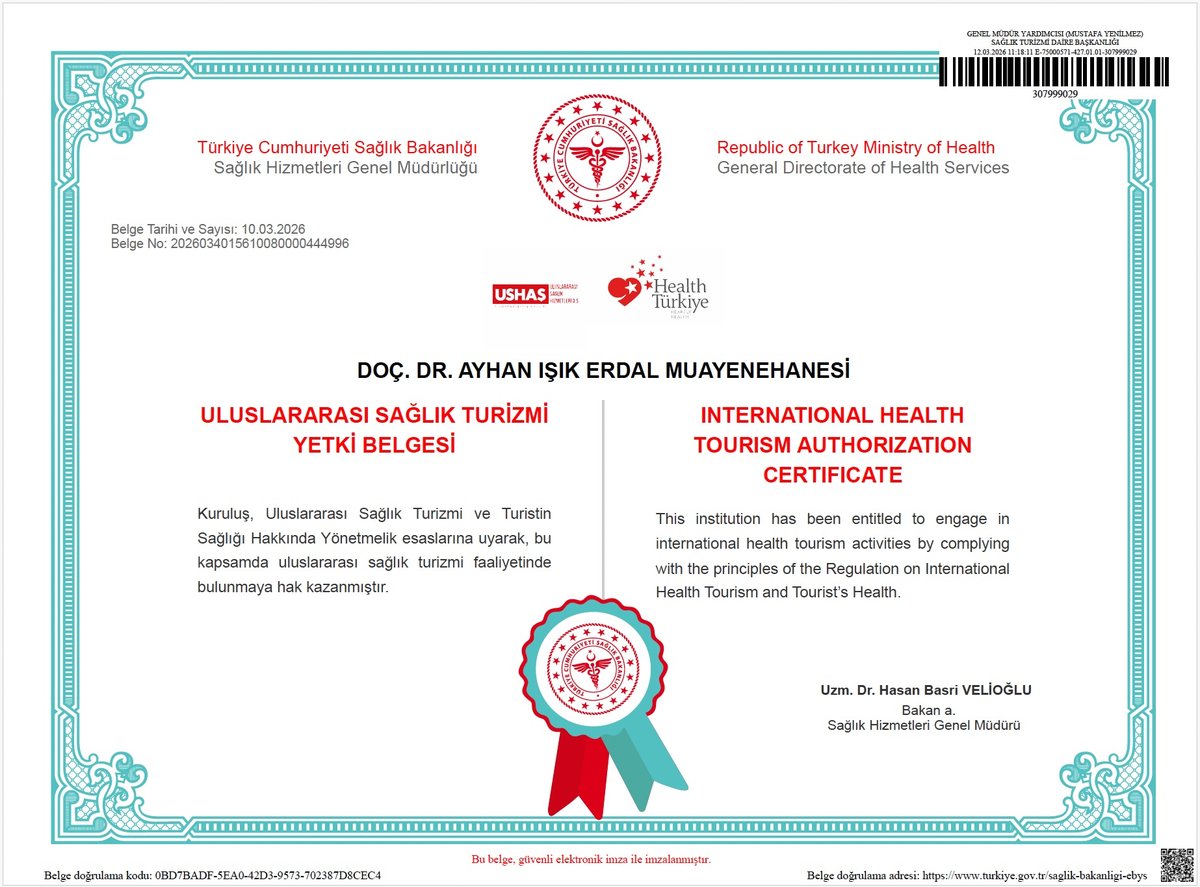
This clinic is officially authorised by the Republic of Türkiye Ministry of Health (Sağlık Bakanlığı, General Directorate of Health Services) to provide international health tourism services. The Ministry audits the clinic's surgeon credentials, facility standards, infection-control protocols, and complication-tracking systems before issuing this certification.
Click certificate to view at full resolution. Document carries digital signature and QR-code verification on the original.